
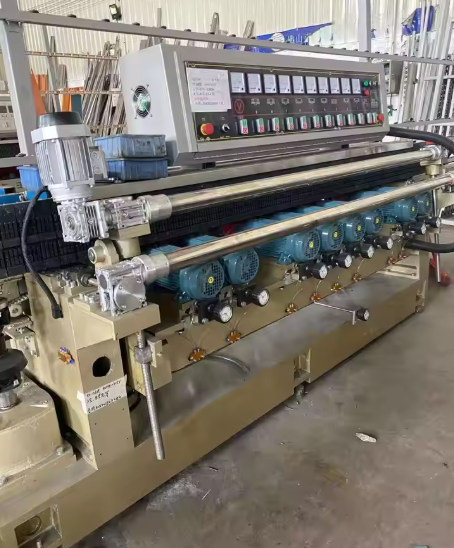
On the line, the furnace door drops and the glass moves—straight into the quench, over to the bending station, or through the lamination press. That cooling segment is where yield gets made or squandered. When the cooling control heater can’t hold its end, the thermal profile wanders, edge stress shows up, and you’re left stacking off-spec sheets. What you need is a heater that holds the setpoint, follows the curve, and repeats it shift after shift. We built the Glassware Cooling Control Heater for plants that run tempering, bending, lamination, coating drying, and insulating glass sealing—operations that live and die by tight tolerances. This isn’t a generic heat source. It’s a production tool, engineered to steady the cooling phase where glass is most sensitive to thermal shock and residual stress.
What matters, technically
A cooling control heater has to deliver stable, controllable heat without hot spots or drift. In practice, that comes down to three things: picking the right emitter, getting the response time right, and making sure it plugs into your machine cleanly. We lean on short-wave quartz infrared emitters because they snap on and off fast—response is on the order of seconds. That lets the heater track temperature during quench transitions and hold tight during dwell. Quartz also runs clean, so you don’t get outgassing that fouls coatings or leaves deposits on the glass. The unit is sized and wired for industrial duty cycles. Typical configurations run 230–460 V, with power density matched to application width and line speed. The heating zone is laid out for uniformity, so you don’t see striping or edge bands. The frame fits standard mounting footprints, and you can spec terminal blocks or industrial connectors so the heater drops into existing lines without a major tear-out. Control matters as much as output. The heater integrates with your instrumentation—thermocouples and PLC—so programmed ramps and holds are repeatable. In lamination, you can set a profile that manages EVA flow without overshoot. In tempering, you stabilize the cooling rate to hit target stress without over-quenching. In insulating glass, you keep seal integrity by controlling edge temperature during secondary sealing.
Why it holds up on real lines
Tempering lines punish inconsistent cooling. If the heater can’t hold quench temperature, the center cools faster than the edge and stress goes non-uniform. Rejects show up as breakage in inspection—or worse, as field failures. This heater keeps the quench profile repeatable across shifts, so curvature, break pattern, and yield stay consistent. Bending stations need tight thermal management after the initial sag. The glass has to be held at a controlled temperature while it sets, or spring-back changes the shape. The cooling control heater holds that post-form temperature steady, so the bend stays within tolerance and the glass doesn’t warp back. Lamination presses run on time and temperature. EVA and SGP need a narrow thermal window to flow, bond, and degas without scorching. The heater gives fast response at the cooling boundary, so the profile stays on target from sheet one to sheet a thousand. That means fewer voids, fewer edge defects, and less scrap. Coating lines are sensitive to thermal gradients. If the drying/curing zone is unstable, you get uneven film build, hazing, and adhesion problems. The heater stabilizes controlled cooling after the cure, preventing thermal shock and keeping film uniform. Insulating glass lines live and die on a consistent secondary seal. If the edge heater fluctuates, the sealant cure changes and you risk weak bonds and moisture ingress. This unit holds edge temperature so the seal is uniform around the perimeter—every time. Automotive glass lines can’t tolerate stoppages. The heater is built for continuous duty, with materials chosen for thermal cycling and vibration resistance. It runs all shift, every shift, without drifting. Energy use adds up fast. Short-wave infrared heats the glass directly instead of heating air, so you waste less on convection and reheat. The heater turns on when needed and shuts down quickly, matching the line’s rhythm. That shows up as lower kWh per sheet.
What you need to know up front
This is industrial equipment, not a benchtop box. Installation needs proper electrical provisioning and thermal clearance. The heater has to be aligned to the glass path—misalignment creates uneven heating and kills the profile. Keep the emitter path clear; quartz infrared performs best when dust and oil aren’t in the airflow. Compatibility comes down to your machine interface. We can supply the heater with standard terminals or a compatible connector, but the control strategy has to match your PLC and instrumentation. If you’re running a proprietary control scheme, integration is still possible, but it requires a clean handshake between heating output and temperature feedback. Maintenance is straightforward, but it isn’t zero. Quartz emitters age. We set replacement windows based on your run hours so you plan downtime instead of chasing failures. High humidity can accelerate thermal stress on components; if your plant runs humid, a protective enclosure and routine inspection make sense. If you want fewer rejects, stable profiles, and uptime you can count on, this cooling control heater is the practical upgrade that pays back quickly. It’s engineered for the realities of the glass line—fast cycles, tight tolerances, and schedules that don’t bend. Run it, measure it, and let the yield tell the story.